
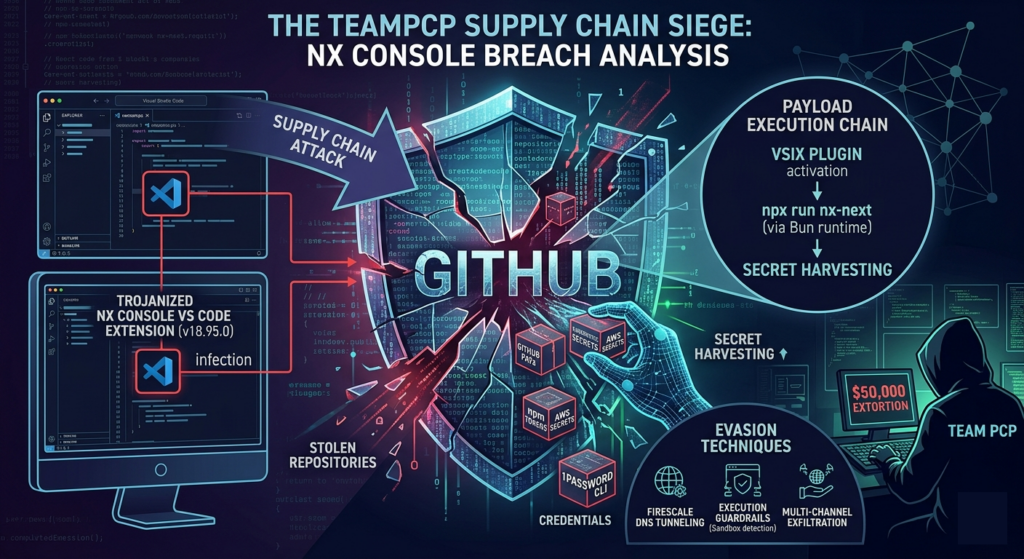
On May 19, 2026, a GitHub employee’s workstation was compromised via a trojanized Visual Studio Code (VS Code) extension, leading to the unauthorized cloning of approximately 3,800 internal GitHub repositories. Officially confirmed by GitHub on May 20, 2026, the breach was attributed to the financially motivated threat actor known as TeamPCP (also tracked as UNC6780). This research paper provides a detailed technical analysis of the attack vector, the execution chain of the malicious payload, the threat group’s advanced evasion techniques, and recommended security hardening measures for enterprise developer environments.
1. Introduction
Modern software supply chain attacks increasingly target the implicit trust placed in developer environments and third-party tooling. The May 2026 GitHub internal repository breach exemplifies this structural vulnerability. Rather than relying on complex zero-day exploits, the attackers weaponized a legitimate Integrated Development Environment (IDE) extension to inherit the developer’s elevated access rights. The perpetrators, TeamPCP, successfully exfiltrated GitHub’s proprietary internal codebases and subsequently attempted to extort the organization for $50,000 on a cybercrime forum.
2. Threat Actor Profile: TeamPCP (UNC6780)
TeamPCP operates as a prolific cybercriminal syndicate specializing in software supply chain compromises. Since March 2026, the group has executed a cascading series of attacks targeting foundational developer tools, including TanStack, Trivy, and LiteLLM. Their methodology typically avoids traditional perimeter defenses by co-opting valid credentials, authenticated sessions, and unverified developer tooling.
3. Technical Analysis of the Attack Vector
The intrusion was initiated through the deployment of a compromised build of Nx Console (version 18.95.0), a popular VS Code UI extension for the Nx monorepo toolchain.
3.1. Initial Execution Trigger
In its legitimate state, Nx Console activates upon editor readiness (onStartupFinished) and is permitted to execute shell commands to build and run Nx tasks. The malicious 18.95.0 build preserved the legitimate Nx Console functionality (the ~7.7 MB main.js file) but appended a silent, malicious payload execution.
To avoid raising suspicion, the extension disguised its malicious action as a routine Model Context Protocol (MCP) setup task (install-mcp-extension). Upon startup, the trojanized extension silently executed an npx command directed at a fixed Git commit on the official nrwl/nx repository.
3.2. Payload Delivery: The nx-next Dropper
The VS Code extension (the VSIX file) functioned merely as a trigger; it did not embed the credential stealer directly or make malicious API calls itself. Instead, the npx command downloaded a minimal package named nx-next from the targeted Git commit. Utilizing the Bun runtime as a dependency, execution occurred seamlessly through the bin field when npx ran the package, bypassing the need for preinstall or postinstall scripts.
3.3. Credential Harvesting
Running as a background process, the nx-next dropper systematically scraped developer secrets from the local disk, environment variables, and Linux process memory. The targeted assets included:
- GitHub personal access tokens (PATs)
- npm authentication tokens (
.npmrc) - AWS credentials (from IMDS and environment variables, e.g.,
~/.aws/credentials) - HashiCorp Vault tokens and Kubernetes service account secrets (
~/.kube/config) - 1Password CLI sessions and SSH private keys
- Cloud provider configurations and AI tool credentials (e.g., Claude Code files)
4. Exfiltration, Evasion, and Persistence Tactics
TeamPCP designed the exfiltration framework to be highly resilient, ensuring that blocking a single outbound path would not stop data theft.
4.1. Multi-Channel Exfiltration
The stolen credentials and cloned codebases were exfiltrated simultaneously via three distinct channels:
- Encrypted HTTPS to a remote attacker-controlled server.
- The GitHub API, leveraging the victim’s own stolen tokens to create public repositories acting as data dead-drops. The malware uploaded encrypted credential files (e.g.,
results.json) into these public repositories. - DNS Tunneling as a fallback mechanism.
Additionally, on macOS endpoints, the payload installed a persistent backdoor that utilized the GitHub Search API as a covert command-and-control (C2) channel.
4.2. Evasion Techniques (FIRESCALE)
To maintain dynamic C2 infrastructure without relying on static domains, TeamPCP utilizes an evasion technique dubbed FIRESCALE. The malware issues search queries to the GitHub API (specifically querying the string q=FIRESCALE) and leverages GitHub commit messages as dead-drop resolvers to retrieve updated command-and-control URLs dynamically. The group also employs execution guardrails, terminating malicious processes if a sandbox environment is detected via CPU core counts or specific system locales (e.g., LANG=ru_*).
4.3. Secondary Infections and Destructive Capabilities
The broader TeamPCP ecosystem incorporates a self-propagating worm known as Mini Shai-Hulud, which automates the compromise of package maintainer accounts across npm and PyPI. Secondary parasitic infections, such as PCPJack, have also been observed hijacking infrastructure previously compromised by TeamPCP, establishing persistence via systemd services like sys-monitor.service or pgsql-monitor.service.
In certain geolocated targets (specifically Israeli or Iranian infrastructure), the malware has demonstrated destructive capabilities. The payload downloads an audio file (RunForCover.mp3) which precedes an rm -rf /* disk wiping routine.
5. Impact and Incident Response
Using the stolen secrets, the attackers successfully cloned roughly 3,800 of GitHub’s internal codebases. GitHub incident response isolated the endpoint, removed the extension, and immediately rotated critical credentials (prioritizing the highest-impact secrets first) on the same day the breach was detected.
Forensic assessments confirmed that the exfiltration was strictly confined to internal organizational repositories; no customer data, enterprise environments, or private user repositories were compromised.
6. Defensive Strategies and Recommendations
Because IDE extensions like VS Code lack strict, capability-based permission models, organizations must proactively harden developer environments. Recommended mitigations include:
- Audit IDE Extensions: Search for recently installed, unverified, or overly permissive extensions. Implement strict allowlists restricting extension installations to verified publishers.
- Strategic Credential Rotation: Prioritize the rotation of GitHub PATs, OAuth tokens, and cloud credentials (AWS, Azure, GCP).
- Eliminate Static Secrets: Transition developer access to short-lived ephemeral tokens utilizing IAM Roles Anywhere or OIDC.
- Deploy Behavioral EDR Alerting: Implement endpoint telemetry to detect IDEs (like VS Code or Cursor) spawning unauthorized child processes, or anomalous automated attempts to read sensitive files like
~/.aws/credentialsor~/.kube/config. - Monitor GitHub API Logs: Hunt for network traffic querying
q=FIRESCALEor the programmatic creation of public repositories by employee accounts with suspicious descriptions (e.g., “A Mini Shai-Hulud has Appeared”).
7. Conclusion
The TeamPCP breach of GitHub highlights a critical vulnerability in the modern development lifecycle: the blind trust extended to developer tooling and IDE plugins. By weaponizing a widely used VS Code extension, the threat actors seamlessly bypassed traditional endpoint defenses to harvest sweeping cloud access and clone proprietary intellectual property. Securing the software supply chain now strictly requires treating the developer workstation as a high-risk attack surface.